On the 31st of December, 2021, Nigeria’s President, Muhammadu Buhari, signed the 2021 Finance Bill [which is now Finance Act 2021] into law. The Finance Act 2021 [hereinafter referred to as “the Act”], came with changes to the Nigerian taxation sphere and also touched on regulations. Through the Act, provisions in other legislations such as Capital Gains Tax Act, Personal Income Tax Act, Tertiary Education Trust Fund Act, Companies Income Tax Act, etc. were also amended. These changes consequently have effects on the running of business operations in Nigeria. Some of them include:
1. Companies Income Tax [CIT]
Before the advent of the 2021 Act, organizations which were involved in educational activities enjoyed exemption from taxation. Now, by virtue of Section 7 of the Act, such companies are subject to Capital Income Tax [CIT].
2. Tertiary Education Tax Rate
The previous rate for the Tertiary Education Tax was capped at 2% on the assessable profit of companies registered in Nigeria; But according to Sections 28 & 29 of the Act, this has been increased to 2.5%. However, this tax does not apply to small businesses. Also, within 30 days of receiving a notice of assessment from the FIRS, any company subject to Tertiary Education Tax must pay within 30 instead of the 60 days which was obtainable under the previous dispensation.
3. Sugar Tax
The Act also amended the Customs, Excise Tariffs, Act[CETA] through the introduction of the so-called “Sugar Tax” in Section 21(3), CETA. This new provision imposes an excise duty of N10 per litre on non-alcoholic, carbonated and sweetened beverages. A rationale behind it is to discourage excessive consumption of sugar in beverages and drinks. This definitely, would have a rippling effect on companies manufacturing such beverages as they would be forced to increase the price of selling their products and consumers will bear the resulting brunt.
4. Capital Gains Tax
Previously, the Capital Gains Tax Act [CGTA], provided that capital gains which accrue to a person from the sale of shares or stocks could not be charged. However, as a result of Section 2 of the Act which amends Section 30 of the CGTA, now there is an imposition of Capital Gains Tax on gains earned from disposal of shares. This however has a certain financial threshold of N100 Million and other conditions which must be considered.
Conclusion
The Finance Act of 2021 has amended quite a number of statutes with the aim of making sure new taxes are now imposed on certain kind of transactions and business owners have no choice but to adapt to these modifications. As gleaned from the above, the new legislation may not necessarily be bringing good tidings for some businessmen. This is obviously due to the new taxes and duties levied on transactions which was not the case under the old dispensation.
TEAM VERNIA 52B, Adeyemo Akapo Street,Omole Phase I Estate, Off Agidingbi Road, Ikeja, Lagos. +234 813 830 6975 [email protected]
In preparation for unforeseen or uncontrollable events which may come to light in the course of executing contractual obligations, parties to the contract may insert the Force Majeure clause. The clause entitles parties to a contract to be discharged from carrying out their obligations in the contract as a result of certain specified unforeseen events or events beyond the control of the parties. The consequence of a Force Majeure clause is that any party unable to fulfil its own part of the contract would be excused from performance or the time for execution will be extended to allow the party carry out their obligations.
The Court of Appeal in its decision in Globe Spinning Mills Nigeria Plc. v. Reliance Textile Industries Limited [2017] LPELR – 41433 [CA] reiterated the importance of including a Force Majeure clause in contracts. By virtue of the unexpected global pandemic, the Force Majeure clause has become one of the most essential in Company Contracts. Numerous companies rely on this clause to alleviate the risk of non-performance and take away liability for inevitable and unforeseen occurrences, for example the COVID-19 Pandemic.
Elements of Force Majeure
There are certain indispensable conditions prerequisite to a Force Majeure clause availing the party seeking to leverage on it. These conditions were highlighted by the Court of Appeal in Diamond Bank Ltd V. Ugochukwu (2008) 1 NWLR (Pt. 1067) per Rhodes- Vivour, J.C.A [as he then was]:
“…there must be an event which significantly changes the nature of the contractual rights of the parties that it would be unjust to expect the parties to perform those rights such as: (1) Where the subject matter of the contract has been destroyed, or is no longer available. (2) Death or incapacity of a party to a contract. (3) The contract has become illegal to perform as a result of new legislation. (4) A contract can be frustrated on the outbreak of war. (5) Where the commercial purpose of the contract has failed.”
As rightly stated by Abdu Aboki, J.C.A in Federal Ministry Of Health v. Urashi Pharmaceuticals Ltd [2018)] LPELR 46189 [CA], for an event to be considered as Force Majeure, it has to be unforeseen at the time of entering the contract. The occurrence must be one that could not have been imagined by any reasonable man and inevitable to the parties of the contract. It must also not be as a result of negligence, an act or omission of any of the parties to the contract, the events include both natural and human acts, for example riots, strikes or war.
Essence of Force majeure Clauses
Recently Nigeria Liquefied Natural Gas [NLNG] invoked the Force Majeure clauses in all its Sales and Purchase Agreements (SPA) as a result of its inability to carry out its operations due to the flood in their operational areas, thereby excluding themselves from any liabilities that may arise as a result of the floods causing their inability to operate. Taking into consideration the recent occurrences around the world i.e. the COVID-19 Pandemic, unpredictable weather changes etc., the importance of inserting a Force Majeure clause in contracts cannot be overplayed.
Having a detailed, well-structured and unambiguous Force Majeure clause will save many contractual agreements, while protecting the parties from immense loss and even lawsuits.
Invocation and Limitation
The party relying on Force Majeure has to prove that it is truly incapable of fulfilling its contractual obligations as a result of the occurrence of the event stated in the clause, it must also prove that there was no way it could have foreseen the event.
A Force Majeure claim will not be upheld by the Court simply because the situation is difficult or the circumstances slightly changed; such an event must be one that could possibly not have been envisioned.
These limitations are vital to note because regardless of a Force Majeure clause, the party to a failed contract can still take action against the executor once there is the slightest possibility that such act could have been envisaged. Thus, a Force Majeure Clause can be used as a shield to protect oneself from liability. On the other hand, it can be a sword, to be used against the defaulting party to ensure fulfillment of his obligation.
A Force Majeure is also restricted to the events and the implications of the occurrence of such events covered under the clause.
Conclusion
It is important to note, for parties inserting the clause, it must be couched properly to avoid ambiguity and various interpretations.
Finally, regardless of how well a contract is drafted, the allowance for unforeseeable occurrences should always be created with comprehensive steps to alleviate the effects of such events that could not have been anticipated.
TEAM VERNIA 52B, Adeyemo Akapo Street,Omole Phase I Estate, Off Agidingbi Road, Ikeja, Lagos. +234 813 830 6975 [email protected]
It is beyond prevarication or doubt that proper regulations by the government of a state are indispensable for the proper functioning of economies and societies. The main objective for any such regulation is to ensure that the regulation works effectively, and is in public interest. This is why it is quite commendable that on the 19th day of October, 2022, the President of Federal Republic of Nigeria signed the Nigeria Startup Act, 2022 [the Act] into law, thus positioning Nigeria’s startup economy as the leading digital hub in Africa.
Definition of Startup
The Interpretation section of the Act defines Startup as “a company in existence for not more than ten [10] years, with its objective being the creation, innovation, production, development or adoption of a unique digital technology innovative product, service or process” See, Section 47 of the Act.
Basically, Startups are young companies founded to develop a unique product or service, bring it to the market and make it irresistible and irreplaceable for customers. It is a company typically in the early stages of its development.
Objectives Of The Act
Section 1 of the Act provides for the objectives of the Act as follows:
Provide a legal and institutional framework for the development of startup in Nigeria;
Provide an enabling environment for the establishment, development and operation of startups in Nigeria;
Provide for the development and growth of technology-related talents; and
Positioning Nigeria’s startup ecosystem, as the leading digital technology centre in Africa, having excellent innovators with cutting edge skills and exportable capacity.
Application Of The Act
From Section 2 of the Act, it is clear that the Act only applies to companies incorporated under the Companies and Allied Matters Act and granted the startup label and organization and establishments, whose activities affect the creation, support, and incubation of labelled startups in Nigeria.
Highlights and Benefits of the Act
Establishment of the National Council for Digital Innovation and Entrepreneurship [the Council]: Section 3 of the Act establishes the Council which is comprised of the President and Vice-President serving respectively as Chairman and Vice-Chairman of the Council, as well as other stakeholders who were commendably carefully curated to draw support of the Executive Government to provide policy and encourage greater collaboration between the State and the private sector. The Council shall be a body corporate with the responsibility to formulate and provide general policy guidelines for the realization of the objectives of the Act together with other functions and powers as clearly stated in Section 7 [1] & [2] of the Act.
Secretariat of the Council:By the provisions of Section 9 of the Act, the National Information Technology Development Agency [NITDA] is designated to serve as the Secretariat of the Council [the Secretariat] to be headed by the Director General of the NITDA. The secretariat’s role has been designed to help operationalize the function of the Council and its functions are clearly started in Section 9 [2] [a-r] of Act.
Startup Support and Engagement Portal: Section 10[1] of the Act establishes the Startup Support and Engagement Portal [the Portal] to serve as a flatform through which a startup conducts registration with relevant Ministries, Departments and Agencies [“MDAs]. It also facilitates the issuance of permit or licence to labelled startups amongst other function as contained in Section 10[2] [a-l] of the Act. There shall also be a coordinator of the Portal who is responsible for maintaining a register of labelled startup in Nigeria and keeping relevant documents/record. The office of the Coordinator of the Startup Portal is provided under Section 11 of the Act.
Startup Labelling Process: Section 13[2] of the Act defines “Labelled Startups” as registered limited liability companies that has been in existence for a period not more than ten years from the date of incorporation involved in innovation, development, production, improvement, and commercialization of a digital technology innovative product or process. One of the eligibility requirements for the grant of a startup label is that it must have at least one-third local shareholding held by one or more Nigerians as founder or co-founder, amongst others. Once a company becomes a labelled startup, it is obligated to comply with the provisions of the Act and all extant laws governing businesses in Nigeria. Other obligations are as provided in Section 16 of the Act.
General Incentives for Startups:
Establishment of Startup Investment Seed Fund [the Fund]: Section 19 [1] of the Act establishes the Fund to be managed by the Nigeria Sovereign Investment Authority. The Act provides that there shall be paid into the Fund on an annual basis, as un not less than Ten Billion Naira from sources to be approved by the Council. The Fund may provide financial support and early-stage finance to labelled startup, and also provide relief to technology laboratories, accelerators and hubs as provided by Section 19 [3] of the Act
Training, Capacity Building and Talent Development: Section 21 and 22 of the Act provides that the Secretariat shall implement a training capacity building programme for Startups and also establish centres for acquisition of technology in the six geopolitical zones of Nigeria for the promotion of digital technology utilization, strengthening of digital technology management capability and information systems. These centres would achieve this through collaboration with relevant agencies, the private sector and supporting the activities of related academic research institution.
Protection of Intellectual Property Rights: The Act acknowledges the importance of intellectual property rights towards the growth and development of startup. The Secretariat, as part of its objectives, must ensure that holders of intellectual property rights are encouraged to exploit these rights and the Secretariat shall also take steps towards assisting startups in institutionalizing and commercializing their rights. See; Section 31 of the Act.
Tax and Fiscal Incentives: The Act provides several tax and fiscal relief for labelled startup. By Section 24 of the Act, a labelled startup operating in eligible industries under the Pioneer Status Incentives [PSI] Scheme may apply through the Secretariat to the Nigeria Investment Promotion Commission [NIPC] for grant of tax relief and incentives under the PSI. If granted, this would entitle the labelled startup to a tax holiday for an initial period of three years, which may be extended for an additional two years. Furthermore, by Section 25 [2] of the Act, a startup may also be exempted from payment of income tax or any other tax chargeable on its income or revenue for up to five years, subject to certain qualifications.
While the above listed incentives are not exhaustive, it should be noted that the incentives conceived under the Act apply not just to the startups, but also the wider ecosystem.
6. Regulatory Compliance for Startup: Below are some of the basic regulatory compliances that Startups in Nigeria need to comply with:
Corporate Affairs Commission: As provided under the Companies and Allied Matters Act, 2020, all companies in Nigeria must be incorporated under CAC before commencing operation and Annual returns must also be filed.
Tax Remittance: All Startups are required to register for tax and file their audited accounts and tax computations with the Federal Inland Revenue Service [FIRS] within eighteen [18] months of incorporating their company or not later than six [6] months after its accounting period, whichever is earlier. Value Added Tax [VAT] are also to be remitted to FIRS monthly except where tax incentives have been granted to such startup company.
Special Control Unit Against Money Laundering [SCUML]: This is a unit under the Economic and Financial Crime Commission [EFCC] and some designated non-financial institutions are required to register with the Special Control Unit to obtain the SCUML Certificate.
Conclusion
The Nigeria Start up Act, 2022 is a fundamental step in the development of a legal framework for startups operating in Nigeria as there are adequate provisions and benefits which if effectively and practically implemented will aid the ability of the Act to achieve its objectives and also ensure that Nigeria Technology ecosystem remains in the global market.
TEAM VERNIA 52B, Adeyemo Akapo Street,Omole Phase I Estate, Off Agidingbi Road, Ikeja, Lagos. +234 813 830 6975 [email protected]
A Contract is simply an agreement between two or more parties that is legally binding. Simply put, it is an agreement that the law will enforce.
A Memorandum of Understanding on the other hand, is a preliminary to a Contract. It is an agreement that a contract will be entered between parties in future. Perfectly put by the Court of Appeal in Aburime & Anor v. Osunbor [2022] Lpelr-57590 [Ca]:
” Memorandum of Understanding is not the real agreement but a document guiding the future agreement. Its status is something less than a complete contract.……The implication is that its content cannot be enforced. Be that as it may, it remains a document which the parties can refer to for the purpose of reminding them of the content therein.” Per Bola, J.C.A. [PP 11 – 12]
Also, in B.P.S Construction & Engineering Co. Ltd V. Fcda [2017] Lpelr-42516 [Sc], the Supreme Court held per Kekere-Ekun, J.s.c (Pp 20 – 21 Paras B – B):
“…it is clear that a memorandum of understanding or letter of intent, merely sets down in writing what the parties intend will eventually form the basis of a formal contract between them. It speaks to the future happening of a more formal relationship between the parties and the steps each party needs to take to bring that intention to reality.
Therefore, it is clear as crystal that an MOU is not to be enforced. It is a preliminary to a future Agreement to be entered into by contracting parties. An MOU is for the future.
However, for every law, there is an exception. There is a way whereby an MOU can still be deemed an agreement which the Courts would recognize as binding on the parties. Where the parties to an MOU agree to be bound by the terms and conditions, none of them is permitted to later aver that the MOU is not binding. The rules of Estoppel forbid such party. The Court of Appeal in Tower Securities & Investment Co. Ltd. v. Coronation Merchant Bank Ltd (2020) Lpelr -51415 (Ca) per Aliyu, J.c.a (Pp 34 – 36 Paras A – E) explained:
“There is no doubt that an MOU’s status is less than a complete contract. But in the peculiar facts and circumstances of this case under which the MOU was executed, I am confident to hold that the parties intended to be bound by the terms thereof. ……………In the case of B. P. S. Construction Company & Engineering Ltd Vs. FCDA (2017) 10 NWLR (Pt. 1572) 1 or (2017) LPELR-42516 (SC)..………… both this Court and the Supreme Court held in that case, that the parties did not intend to be bound by the MOU, since it only represented a preliminary understanding of the parties’ plan to enter into a contract in the future. But in the case leading to this appeal, the parties did not make the MOU subject to the execution of any further agreement. They intended that it should be binding on them and indeed commenced the execution of the terms therein as noted supra. In this circumstance, the Appellant cannot be allowed to renege from it.”
Also, the Supreme Court held in Adedeji v. Obajimi [2018] 16 Nwlr Part 1644 Page 146 that an MOU was enforceable because the parties intended to be bound, they had intentions to create a legal relationship. The Appellant signed the MOU to pay the sum of N5,000,000 to buy a company [at a particular date] and also a statutory deposit of N500,000 to the Central Bank of Nigeria. It was agreed that in the event of an inconclusive sale, the Appellant would be reimbursed the money incurred for expenses. But the Appellant did not pay the N5,000,000 and he sued for reimbursement. The Apex Court held that he had breached the terms of the MOU as he failed to perform his contractual obligations. There was an intention to be bound and he breached the agreement. Therefore, the MOU was enforceable.
From the above decisions, there is an emphasis to intention to create legal relationships. This element is usually what differentiates contracts from mere agreements. Offer, Acceptance, Consideration and Capacity might all be present but no agreement will receive the force of law if it lacks an intention.
Conclusion
Memorandums of Understanding are generally unenforceable. There are usually preliminaries to future agreements. However, where parties intend to be bound, then they are placed on the same pedestal as Contracts and consequently receive the stamp of enforceability, in which case a Memorandum of Understanding is a binding obligation. Where there is intention, it is no longer a preliminary; it is a debt to be paid. An MOU is thus, an IOU.
TEAM VERNIA 52B, Adeyemo Akapo Street,Omole Phase I Estate, Off Agidingbi Road, Ikeja, Lagos. +234 813 830 6975 [email protected]
The ongoing political drama in Rivers State surrounding Governor Nyesom Wike and the House of Assembly of Rivers State together with Sir Celestine Omehia appears to be far from over. It has left quite a number of people concerned about the state of governance in Rivers State and Nigeria as a whole. Is this an obvious case of abuse of power or a noble act to correct a wrongful act?
Brief History
On the 26th of January 2007, Rt. Hon. Chibuike Amaechi commenced a suit at the Federal High Court, Abuja against Independent National Electoral Commission [INEC] and eventually joined Sir Celestine Omehia and the People Democratic Party [PDP] as parties to the suit. The case was appealed up to the apex Court in Nigeria [the Supreme Court] and the facts of the case are summarized thus: Amechi, a member of PDP, in his quest to be the Gubernatorial candidate of the party in the April 2007 contested the party primaries and emerged the winner. PDP submitted Amaechi’s name to INEC as PDP Gubernatorial candidate for the party but subsequently substituted Omehia’s name for Amaechi without giving cogent and verifiable reasons for the substitution as required by the Electoral Act, 2006.
The Supreme Court found in favor of the Rt. Hon. Chibuike Amaechi. The Court held that the PDP did not give sufficient reasons for substituting Amaechi’s name for that of Omehia. The reason for the substitution did not fulfil the requirements as provided under Section 34 of the Electoral Act. Thus, the substituted candidate’s victory in the election was irrelevant as his participation in the election was improper. The apex Court held that since the party’s candidate was not adequately removed, the campaign for votes done by the party was done in favour of the Chibuike Amaechi and he was the winner of the election, since PDP had won the election. He was thus the Governor of Rivers State by virtue of the political party winning the election. The Apex Court held that the participation of Celestine Omehia in the election was an illegal act and he could not be heard to claim benefits for his illegality. [See; AMAECHI V. INEC & ORS 2008 LPELR – 446 SC]
The First Resolution
By virtue of the judgment of the Supreme Court, Sir Celestine Omehia was Governor of Rivers State from 29th of May 2007 to 25th of October 2007 [about five months]. However, contrary to the Supreme Court’s well elucidated Judgment, the state government vide an instrument published in the official gazette of the Rivers State of Nigeria No. 5, Volume 52 of March 2016 under the hand of Governor Nyesom Wike recognized Sir Celestine Omehia as a former governor and restored all his privileges and entitlements.
The Derecognition
It is indeed thought-provoking that seven years after the laudable/detestable decision [depending on where one stands] of Governor Nyesom Wike and the State House of Assembly to accord due recognition to Celestine Omehia as a former Governor of the state, a fresh motion has now been passed to derecognize him based on the same Judgment of Court that was very much potent and valid as at the time the initial recognition was approved.
On the 6th of October, 2022 a motion was presented by Amaewhule Martins Chike titled “Motion to rescind the Rivers State House of Assembly on the recognition of Sir Celestine Omehia as former Governor of Rivers State and the Restoration of all the benefits and entitlement due to him”. The said entitlement received totaled Six Hundred Million Naira [N600,000,000.00] in benefits and Ninety-Six Million, Five Hundred Thousand Naira [N96,500,000.00] as monthly pension as of September, 2022.
All 21 members of the House present at the plenary voted in favour of the motion and the House adopted the resolution. Governor Wike, probably due to his recent fall out with Omehia, swiftly approved the motion as soon as it got to him. He explained that the recognition given to Sir Celestine Omehia was made in error and with the signing the recognition accorded in addition to accruable rights and benefits are cancelled. The Legal advice from the State Attorney General, which was apparently sought this time, termed the recognition as being “extrajudicial”. One would then wonder why proper legal guidance was not initially sought.
Political Vendetta or Not: Legal Implications Of The Derecognition
Without the rigor of any legal process, the State Government of Rivers State thought it reasonable to restore the dignity and recognition of Sir Celestine Omehia regardless of the existence of a Supreme Court Judgment where the position of the law on the issue was made clear.
It should however be noted that there seems to be an apparent conflict on the interpretation of the Supreme Court Judgment. On one hand, it was interpreted that the Supreme Court was clear that Omehia in the eyes of the law was never a Governor in Rivers State. On the other hand, it was interpreted that the Judgment of the Supreme Court did not make pronouncement on Omehia status as governor or otherwise rather, all the apex court said was that in the eyes of the law, Omehia was not the valid candidate of PDP.
Regardless of the apparent conflict on the interpretation of the said judgment, can Rivers State Government approbate and reprobate? More so when the government on its own volition decided to restore to Omehia the privileges and entitlement of a former Governor. He never fought, protested or went to Court, soliciting such recognition. The government on its own decided it was the “proper thing to do”. It is clear that consistency is one of the hallmarks of sincerity and excellence and this was further buttressed in the case of Attorney General, Rivers State V. Attorney General, Akwa Ibom State [2011] 29 Wrn 1, where the Supreme Court opined thus:
“It is a rule of equity that, one cannot approbate and reprobate…it is a doctrine of justice and it is inequitable to blow hot and cold, this principle find expression in Latin maxim “Allegans Contraria Non Est Audiendus.” Per BIOBELE ABRAHAM GEORGEWILL JCA[Pp 45 – 46 Paras F – D]
The Apex Court in the case of Ayorinde V. Kuforiji [2022] 12 Nwlr [Part 1843] Pg. 112 Para D also held thus:
“The law is that, a person in the position of respondent will not be allowed to force back the hand of the clock belatedly; having made the appellant change his position and expended monies…, it was too late in the day for the respondent to suddenly wake in a fit of contrived belated awareness…”
Furthermore, it is an established principle of law, by the doctrine of Estoppel that when a person or an establishment [like the Rivers State House of Assembly] has by its declaration, act or omission intentionally caused or permitted a person to believe a thing to be true and act upon such belief, neither it nor its representatives in interest shall be allowed to deny the truth of that thing. See; Section 169, Evidence Act, 2011.
Therefore, if the law forbids reprobation, the implication is that everything said in such reprobation is of no moment, of no use and ought to be discountenanced and disregarded. This principle of law is expressed in the Latin Maxim “Qui Approbat non Reprobat” quite literally translated to “the one who approbates, cannot reprobate” or “that which I approve, I cannot disapprove.”
However, it is worthy of note that the Rivers State House of Assembly has the power to make, enact and pass laws so long as any laws passed by it are within its own legislative competence and authority. Not only can the legislature enact laws, it can also amend any existing law passed by that arm of government as circumstances may permit. This duty on the legislature to enact and even amend existing laws was alluded to by the apex Court in Amoshima V. State [2001] Lpelr 471 [Sc] when it held that:
“It is trite law that whereas it is the duty of the legislature to enact law, that of the judiciary is to interpret the laws so made. It follows therefore that where there is dissatisfaction with the state of the laws as it exists, and a desire for a change thereof is expressed by the people, it is the duty of the legislature which made the law in the first place to effect the needed reforms by amendments thereto. The duty both to make and amend laws so made belongs exclusively, by constitutional arrangement, to the legislature as provided under Section 4 of the Constitution of the Federal republic of Nigeria, 1999.” Per Onnoghen, J.S.C.
It is clear from the above that the House of Assemblies in Nigeria has the unfettered power to make and amend laws provided it so done in obedience to the relevant constitutional provision under which the law was made. By Section 100 [1] of the CFRN, 1999 [as amended], this power is exercised by Bills passed by the House of Assembly and then assented to by the Governor, except otherwise provided. Therefore, it is very much within the remit of the Rivers State House of Assembly to pass a Bill seeking to recognize Omehia as former governor of Rivers State and where so decided, pass another Bill seeking to amend the initial Bill if same was passed in error.
Another issue to be determined is whether Rivers State Government can compel Omehia to refund in seven days all monetary entitlements especially the sum of Six Hundred Million [N600,000,000.00] in benefits and Ninety-Six Million, Five Hundred Naira [N96,500,000.00] in pension received from the state government as at September 2022. Section 124 [5] of the CFRN, 1999 [as amended] provides as follows:
“124[5] Provisions may be made by law of House of Assembly for the grant of a pension or gratuity to or in respect of a person who had held office as Governor or deputy Governor and was not removed from office as a result of impeachment; and any pension granted by virtue of any provision made in pursuance of this subsection shall be charged upon the Consolidated Revenue Fund of the State.”
From the above provision, it is clear that past Governors and Deputy Governors are entitled to payment of pension or gratuity provided they were not removed from office. Rt. Hon. Chibuike Amaechi during his tenure obviously interpreted the judgement of the Supreme Court in Amaechi V. Inec & Ors 2008 Lpelr – 446 SC to mean that Omehia was removed from office and no monetary entitlement due to former governors should be paid to him. Governor Nyesom Wike and his administration on the other hand decided to do otherwise. He assented to the Bill recognizing Sir Celestine Omehia as a former governor of Rivers State and restored the payment of all accompanying entitlements.
Therefore, if the House of Assembly decides to suddenly withdraw that recognition, then the payment of any entitlement should immediately cease. However, compelling Omehia to refund the entitlement received by him while he was “legally” recognized as a former Governor of Rivers State could be interpreted as abuse of power.
For the purpose of fairness and justice, it would indeed be wise for Sir Celestine Omehia to turn to the Judiciary for intervention and redress, as suggested by many. The court would have to determine the legal justification of the refund and whether the House of Assembly can approbate and reprobate in the same breath. The House of Assembly with Governor Nyesom Wike obviously have no desires whatsoever to take responsibility for their initial error and it would be unfair for them to seek to blame or persecute a man who did not protest or fought for any favors.
TEAM VERNIA 52B, Adeyemo Akapo Street,Omole Phase I Estate, Off Agidingbi Road, Ikeja, Lagos. +234 813 830 6975 [email protected]
The forthcoming 2023 General Elections is the most important topic in the Nigerian political sphere being discussed right now. The prominent parties at the forefront are the All Progressive Congress which is flag-borned by former Governor of Lagos State, Asiwaju Bola Ahmed Tinubu; the People’s Democratic Party whose candidate is former Vice-President of Nigeria, Alhaji Atiku Abubakar; and finally, the Labour Party being represented by former Governor of Anambra State, Mr. Peter Gregory Obi.
Jurisdiction
The APC administration while campaigning in 2019 promised Nigerians it would bring a massive change in all strata of governance. It made the same promise in 2019 when seeking re-election. However, the vast majority of Nigerians disagree and insist that the APC government has failed to fulfil its promises. Currently, the rate of insecurity has skyrocketed like never before, the economy has melted down, the Naira currently keeps being devalued on a daily basis, insurgency is no longer a piece of “breaking news” as it is now the norm, amongst other disheartening tales the Nigerian person can easily tell. Yet, the APC wants to contest again.
Questions to answer
After nearly 8 years of ruling, should APC be rewarded with at least another 4 years in power?
After 16 previous years, should the PDP be given the reins of the country again?
Is it time for the Labour Party, whose candidate has a brilliant track record in governance? Should there be a new Sherrif in town who would probably set the ball rolling for good governance, thereby restoring Nigeria back to its glory days?
In the past few months, Labour Party’s candidate, Mr. Obi has been the most popular especially on mainstream social media. His achievements as a former Governor have been brought to the fore of political debates and discussions. His supporters dubbed as “OBIdients” have taken campaign and political awareness to another level. Their passion, grit and doggedness cannot be ignored. This drive to see their preferred choice get to the Aso Rock has also led to several allegations that they have been bullying and attacking members of the opposition parties, especially members of the APC who are popularly called “BATified”, not to cast their vote for the APC. The OBIdients are demanding a truthful change in governance and refuse to back down or be brow-beaten. It is their strong and unshaken belief that the APC government must not be allowed to continue in leading the country. To them, Nigeria has regressed like never before and enough is enough.
Two Sides of A Coin
Everyone has the right to vote a party or person of choice. Article 21, Universal Declaration of Human Rights, 1948 provides that everyone has the right to take part in the government of his country, directly or through his chosen representatives. Section 38,1999 Constitution says that everyone has the right to freedom of thought, conscience and religion. Section 40 goes further, establishing the rights to free assembly and association and that a person can belong to any political party of his choice. These statutes highlights that a person has the right to cast his vote in favor of anyone he chooses to. That is the law. It is an unfettered right and no one should be disenfranchised. That is the right and proper thing. Section 51(2), Electoral Act, 2022 says “no voter shall vote for more than one candidate or record more than one vote in favor of ANY candidate”. This means, you should cast your vote according to your choice.
However, we must take a look at the other side of the table. Is it just to vote in a government that majority of the people are unhappy with? Is it fair to reward, by all acceptable standards of governance, a failed administration which has kept the citizenry in a state of misery, by voting for its continuity? Currently, the Academic Staff Union of Universities [ASUU] has been on strike since February 14th 2022, thereby suspending academic activities and keeping students at home for almost a year, consequently, educational stagnation is inevitable. During the #EndSARS protests that swept the nation 2 years ago, precisely on the 10th day of October 2020, protesters were shot dead at the Lekki Toll Gate, which is today known as the “Lekki Massacre”. The nation has suffered so many cases of injustice from the government in different ways. Jeremy Bentham, the father of the Utilitarian School of Thought argues that the essence of law is to promote collective happiness of the people. Thus, OBIdients insist that to vote in the APC administration would be politically immoral, unfair and unjust despite the fact that the law entitles everyone to vote according to his/her conscience. Narendra Mordi says people power must be combined with good governance to bring about real, deep and long lasting change; good governance cannot remain merely a philosophy, concrete steps have to be taken for realizing its good. The OBIdients who have been resilient and staunch in their support, refuse to back down and are unapologetically unfriendly towards members and supporters of the opposition. This behavior has been branded by many as bullying and hostile but they do not bat an eye lid.
So, the burning question remains, which better reflects Justice: Voting [according to your choice] a candidate that is deemed harmful to collective good of the people or forcefully demanding for better governance and insisting on it vehemently?
What is Justice?
One cannot take away the institution of the law in society. Without it, we are no better than animals. However, the aim of the law is to ensure Justice and foster progress in society. We opine strongly and agree with Bentham that the law is to create happiness for the highest number of people. Therefore, it can be argued that voting in a person that is seen as a threat or harmful to the majority, is “unjust” even though the law gives you a freedom to choose.
According to Le Modesit Jnr., never mistake Law for Justice, Justice is an ideal, and Law is a tool. The BATified believe that they have the right to vote in their preferred choice. This is the law and it is valid because it is a reflection of the provisions of the law. To them, this is justice and it can be argued to be so. However, the OBIdients on the other hand insist that such choice although legal, is unjust on the long term and would have grave consequences. Their stance is akin to the words of Immanuel Kant: “The worst form of Injustice is pretended Justice”.
Yes, bullying and attack should not be tolerated, but can the OBIdients be blamed? Jim Crow laws in the 80’s legalized slavery and yet, that did not make them just. The nation needs a revolution to effect that change it was promised 7 years ago. The people are tired to their bones. Nigerians need to be free from shackles that has kept us bound for so long. At this point, it is seen as a do-or-die affair for many people. Patrick Henry on March 23rd of 1775 said, “give me liberty or give me death”.
It is legal to vote a candidate of choice. However, if that choice is fatal to collective good of the people, it is deemed unjust.
TEAM VERNIA 52B, Adeyemo Akapo Street,Omole Phase I Estate, Off Agidingbi Road, Ikeja, Lagos. +234 813 830 6975 [email protected]
Tax Appeal Tribunal [hereinafter referred to as the “TAT” or “Tribunal”] is established pursuant to SECTION 59 (1), FEDERAL INLAND REVENUE SERVICE [ESTABLISHMENT] ACT, 2007 [hereinafter referred to as the “FIRS Act”]. The TAT replaces the former Body of Appeal Commissioners [BAC] and Value Added Tax [VAT] Tribunals. The TAT is not a Court, but rather an administrative body saddled with responsibilities of handling disputes on taxation; to be specific, taxes accruable to the Federal Government of Nigeria.
Jurisdiction
The 5th Schedule of the FIRS Act states that the TAT has jurisdiction over all matters contained in the 5th Schedule [to the FIRS Act]. These includes: disputes arising from the Companies Income Tax Act [CITA], Petroleum Profit Tax Act [PPTA], Personal Income Tax Act [PITA], Capital Gains Tax Act [CGT], Stamp Duties Act [SDT], Value Added Tax Act [VAT], Taxes and Levies [Approved list for collection] Act as well as other laws, Regulations, Proclamations, Government notices or Rules related to these Acts. Furthermore, it is instructive to note that the Tribunal also adjudicates tax disputes arising from the actions and decisions of state tax authorities provided the disputes relate to any of the Acts listed in the First Schedule to the FIRS Act. There used to be a debate as to which is the appropriate forum to bring federal taxation matters to, whether it is the TAT or the Federal High Court [hereinafter referred to as “FHC”]. Section 251(a) – (c), 1999 Constitution confers upon the FHC exclusive jurisdiction to entertain and adjudicate upon matters related to taxation of the Federal Government or its agencies. Section 59 (2), Establishment Act saddles the TAT with the responsibility of handling disputes relating to taxes due to the Federal Government through the FIRS. Therefore, it begged the question that when there is a grievance, which of the two judicial bodies is the appropriate point of call? Can a complainant bypass the TAT and go straight to the FHC or he must go through the former first? After series of decisions, the Court of Appeal finally put an end to this. In Federal Inland Revenue Service v. TSKJ [Construcoes Internacional Sociadade Unipersoal], [2017] LCN/10279 CA, the Court held that a party must approach the TAT before escalating a grievance to the Federal High Court where a statute prescribes a line of action in resolution of a dispute, all available remedies must be exhausted first before resorting to the halls of a Courtroom. This however, as properly and firmly noted by the same Court of Appeal in the later decision of Skye Bank Plc v. K.S.I.R.S [2021] 12 Nwlr [Part 1789] Page 27], the TAT is not a Court and does not ousts the jurisdiction of a Court.
The TAT Zones
A Tax Appeal Tribunal is located in the Federal Capital Territory, Lagos State and in each of the six geo-political zones of Nigeria.
Initiation of Action
The Tax Appeal Tribunal as defined by the Court of Appeal in Skye Bank Plc v. K.S.I.R.S [supra] is an administrative tribunal set up to determine the correctness of assessment of tax without fixation of formality. When a tax has been imposed on a party, he is free to object to it and lay a complaint to the imposing authority. Upon failure to reach an amicable resolution, such complainant [aggrieved party] has the right to escalate it further by approaching the TAT. The procedures of filing an action under the TAT, like a usual Court, is regulated by procedure and hence the Tax Appeal Tribunal [Procedure] Rules 2021.
According to the FIRS Act and Order 3 Rule 1, TAT [Procedure] Rules 2021, both the taxpayer and relevant tax authority can initiate the appeal process. Rule 2 provides that such complainant shall file the action within a period of 30 days from the date on which the cause of complaint [action, decision, assessment or demand notice] which is being appealed against, was made by the FIRS. However, the Tribunal may still entertain an appeal after the expiration of the said period of 30 days if it is satisfied that there was a reasonable cause for the delay. Going further, Rule 3 says that if the complainant is the FIRS or any relevant tax authority, aggrieved by non-compliance by any person in respect of any provisions of the tax laws referred to in Paragraph 11 of the 5thSchedule to the Act under its administration, it may as in Rule 2 above, file an appeal at the appropriate zone of the Tribunal.
If a party is still dissatisfied with the decision of the Tribunal, Order 1, Rule 1, Federal High Court [Tax Appeal] Rules, 2022 provides that such party can file a Notice of Appeal to the Federal High Court within 30 days after the decision of the Tribunal was given.
Structure
According to Section 2,5th Schedule, Establishment Act, the TAT has a total of 50 Tax Appeal Commissioners. A Tribunal consists of 5 members appointed by the Honorable Minister of Finance. The Chairman for each zone must be a legal practitioner who has been so qualified to practice for a period of not less than 15 years with experience in tax legislation and tax matters. The Chairman presides at every sitting of the Tribunal and in his absence the members shall appoint one of them to be the Chairman. The quorum at any sitting of the Tribunal is 3 members. Section 4 provides that a Tax Appeal Commissioner is to hold office for a term of 3 years, which is renewable for another term of three years only, from the date on which he assumes his office or until he attains the age of 70 years whichever is earlier.
Responsibilities of The TAT
The Tribunal is responsible for entertaining, determining and adjudicating on all the cases filed before it. The Tax Appeal Commissioners sit on the tribunals to perform these duties. Also, where the cases also have elements of crime, it can refer them to the office of the Attorney General of the States or Federation [as the case may be]; or other law enforcement agencies so the matters can be prosecuted. The decision of the Tribunal [Award or Judgement] will be registered at the Federal High Court and enforced as if it was a Judgment of the Court.
Bottlenecks of Dispute Resolution
As gleaned earlier, appeals from the TAT lie to the Federal High Court. Order 1, Rule 1 Federal High Court Tax Appeal [Procedural] Rules, 2022 is instructive on this. However, this can only be done on points of law. The Act provides that appeal against the decision of the Tribunal lies to the Federal High Court “on points of law” and further appeal lies to the Court of Appeal. No room for an appeal on points of facts is made here. This may appear unconstitutional and could be challenged. However, it would also seem that the approach as universal appeal in matters of tax appeal. In addition, the Rules require a deposit of Judgement Sum. Order 5 Rule 1 mandates a tax debtor who is challenging the decision of the Tribunal [“the Tribunal”] to deposit the judgement debt in an interest yielding amount maintained by the Chief Registrar of the Court. Otherwise, the appeal will not be heard. This is a precondition that must be satisfied. In our opinion, it seems unfair to a party being asked to deposit the same amount of money which he is appealing against, before he can make that appeal. It is nothing but a representation of the popular phrase associated with the military which is “obey before complain”. The essence of appealing is to overrule the lower court and prevent that “obedience” from taking place. However, on the flip side, it is argued that this payment to the Government is imperative for the funding of developmental projects. Failure of parties to pay hinders the tasks the Government intends to carry out. Besides, Paragraph 17, 5th Schedule of the FIRS Act mandates this payment to be made as a condition precedent to further appeal. It should be noted that this approach is not unique to Nigeria. It could be found in other tax jurisdictions to a varying degree.
Furthermore, at the TAT, the commissioners who adjudicate the disputes are experts who have experience in taxation. However, the Judges at the Federal High Court where appeals from the TAT will lie to, might not be vast in the realm of taxation and this undoubtedly can scupper the Court from reaching a sound and robust decision. There have been calls for the establishment of a proper Revenue Court manned by Judges appointed from legal practitioners with verse knowledge of and wealth of experience in tax matters and tax dispute resolution.
Conclusion
The TAT has always been a proper forum to ventilate taxation related grievances. Parties do not need to go to Court and endure all the stressful procedure required just before they can seek redress. The Tribunal saves them that long and tedious process. The aim, like any other body tasked with judicial and adjudicatory powers is to determine rights and liabilities and ultimately grant redress being sought by parties who come before it.
However, the system is not perfect as it is fraught with its own shortcomings. The restriction on appeals only on points of law is a not in the interests of litigants as the very Justice they seek before the Federal High Court is already limited. We strongly opine that a balance be struck in the payment of the Judgement Sum as a pre-condition for appeal, which would reflect equity and fairness. Yes, it looks harsh on parties but also, the Government needs the money too. The Law needs an amendment. Then, to ensure well-grounded decisions, forged from solid jurisprudence are reached, devoid of all the stressful procedure and legalese of the regular Courts, we suggest that there should be the establishment of Revenue Courts in line with the prescription of the revised National Tax Policy Document. In fact, the TATs can be transformed into these proposed Revenue Courts while the Chairmen be elevated to the position of Judges.
TEAM VERNIA 52B, Adeyemo Akapo Street,Omole Phase I Estate, Off Agidingbi Road, Ikeja, Lagos. +234 813 830 6975 [email protected]
The recent Money Laundering Act [hereinafter referred to as “MLA”] was enacted in May 2022 to repeal the previous Act of 2011. This latest law like its predecessor is to ensure transparency and disclosure by shining the torchlight on financial transactions, combat money laundering and other related crimes. Penalties as usual, have been prescribed to act as deterrent for anyone, whether natural or corporate, who flouts these provisions.
The Law
Section 2(1) provides that no person or body corporate shall except through a financial institution, make or accept a cash transaction exceeding the sum of N5 Million Naira or its equivalent [in the case of an individual] or N10 Million Naira [in the case of a body corporate].
Section 3(1) imposes a duty to report in writing, a transfer to or from a foreign nation, funds or securities by any person including a money service business, of any sum exceeding $10,000, to the Special Control Unit against Money Laundering [hereinafter referred to as “SCUML”], a unit under the Economic and Financial Crimes Commission, Central Bank of Nigeria and Securities and Exchange Commission, within one day from the date of the transaction.
Section 4 (1) – (12) creates a responsibility on financial institutions and designated non-financial business and profession [hereinafter referred to as “DNBP”] to identify the identities of customers, take reasonable measures to verify anyone acting on their behalf, carry out due diligence while establishing business relationships and transactions, scrutinize transactions, gather sufficient information about customer and their business, etc.
Section 6 (1)says that financial institutions and DNBPs whose profession involves cash transactions shall in the case of a new business, before its commencement and an existing business, within 3 months after the enactment of the Act, submit to the SCUML, a declaration of its activities.
Section 7also imposes a duty to report any suspicious transaction involving a frequency which is unjustifiable or unreasonable, surrounded by conditions of unusual or unjustified complexity, appears to have no economic justification or lawful objective, is inconsistent with the known transaction pattern of the account or business relationship, or is in the opinion of the financial institution or non-financial business and profession involves the proceeds of a criminal activity, unlawful act, money laundering or terrorist financing, and so on.
Section 11 (1)further goes on to say that notwithstanding anything to the contrary in any other law or regulation, a financial institution or DBNPs should report to the Nigerian Financial Intelligence Unite [hereinafter referred to as the “Unit”] in the case of a financial institution and to the SCUML in the case of a designated non-financial business and profession in writing within 7 days, any single transaction, lodgment or transfer of funds in excess of N5 Million Naira or its equivalent [in the case of an individual] or N10 Million Naira [in the case of a body corporate].
In addition, the law has gone a step further to place a burden on society; everyone has a reasonable man’s test to undergo. According to Section 20 (a) and (b), any person who:
“(a) conceals, removes from jurisdiction, transfers to nominees or otherwise retains the proceeds of an unlawful act on behalf of another person, where he knows or reasonably ought to have known or suspected that other person to be engaged in an unlawful act or has benefited from an unlawful act, or
(b) knows or reasonably ought to have known or suspected that any property either in whole or in part directly or indirectly represents another person’s proceeds of an unlawful act, acquires or uses that property or takes possession of it, commits an offence under this Act and is liable on conviction to a fine of at least five times the value of the proceeds of the unlawful act or imprisonment for a term of at least four years but not more than 14 years or both.”
The implication is that no one can feign ignorance about the unlawful nature of a transaction. You are expected to exercise reasonable care when dealing with third parties and a certain level of diligence is expected of you.
The Law and Lawyers
Section 11 (4)expressly states that legal professional privilege and the invocation of client confidentiality shall not apply in connection with:
the purchase or sale of property;
the purchase or sale of any business;
the managing of client money, securities or other assets;
the opening or management of bank, savings or securities accounts;
the creation, operation or management of trusts, companies or similar structures.
One of the basic tenets of the legal profession is confidentiality. Like Religious Priests with congregation members, and Medical Practitioners with patients, the law in jurisdictions worldwide regard the relationship of a lawyer and his client as sacred. Such relationship is built and sustained on the concept of trust. According to Rule 19, Rules of Professional Conduct 2007, a Lawyer and Client communication is privileged. Without consent from the latter, it cannot be disclosed. To do so is a disbarrable offence on the part of the lawyer. The communication between both parties is privileged and generally cannot be used in evidence. Section 192 (1), Evidence Act 2011 provides that the communication between a lawyer and client is privileged. Except with the Client’s consent, the lawyer CANNOT disclose such information. The exceptions are:
a. Where such communication is made in furtherance of a crime; b. Any observation made by the lawyer that since his employment, the Client has committed a crime.
Client-Attorney Privilege is so sacred that in 192 (3), this privilege still exists even if the Lawyer is no longer in the employ of the client. It is important. Thus, a law compelling a lawyer to disclose the transaction of his client is invalid. Therefore, the above provisions of Section 11 (4) MLA 2022 lifting such privilege is an aberration of established rules and principles of law. The Court of Appeal held in Mekwunye v. Carnation Registrars Limited [2021] 15 NWLR Part 1798 Page 1 that even the Court CANNOT compel a lawyer to break confidentiality. Espousing the importance of the concept, Pemu J.C.A @ Pages 40, Paras C – D held:
“The Counsel-Client relationship is fraught and clothed with privilege. Privilege for communication in relation to litigation based on the oath and honour of the lawyer who is duty bound to guard his client’s secrets.”
Privilege is not for fun. It is a duty. Keeping it short yet firm, the words of Daudu, SAN in the proceedings of Nigerian Bar Association v. Moses [2016] 10 NWLR, Page 366 @ 391 Paras F – C:
“The legal practitioner must accept that every privilege comes with a huge baggage of responsibilities.”
When the Old Act was enacted in 2011, the Nigerian Bar Association filed a suit against the Central Bank of Nigeria and the Attorney General, arguing that the provisions compelling disclosure cannot and should not be applied to lawyers because of Client-Attorney privilege. The Court of Appeal in Central Bank of Nigeria v. Registered Trustees of the Nigerian Bar Association & Anor. [2021] 5 Nwlr Part 1769 Page 268 held that although the law did not expressly mention, indeed lawyers were to be exempted from the application of such rule. The National Assembly in its own wisdom then choose to repeal the existing law and enact a new one in its stead and then expressly lift the privilege lawyers enjoy, therefore it would be said to be “what the law now says”. This is a disregard for Rule of Law. The act of the National Assembly in this regard is nothing short of legislative rascality. Client-Attorney Privilege is sacred! It must not be touched. In Agetu v. Commissioner of Police [2020] 13 NWLR Part 1741 Page 245, the Court held that a lawyer CANNOT be compelled to disclose information of his client except where he is a witness and even at that the Court can only permit him to do so if deemed necessary.
The provisions of Section 20 (a) and (b), MLA 2022 in our opinion should definitely not apply to lawyers. A lawyer should not be saddled with the responsibility of investigating the source of his client’s funds or wealth. That is within the remit and responsibility of law enforcement agencies. What he is owed is the perfection of his brief; the payment of his professional fees by the said client. The Court of Appeal, Lagos Judicial Division on May 14th, 2021 dismissed the appeal filed by the Economic and Financial Crimes Commission who froze the accounts of renowned learned silk, Mike Ozekhome S.A.N on the grounds that his professional fees being paid to him by his client were unlawfully acquired. Lawyers enjoy this privilege and it must not be tampered with except in accordance with the due procedure of the law.
Conclusion
Without a shred of doubt, the MLA 2022 is anchored on transparency and disclosure, as the foundations to build the machinery for combating money laundering. The public has a sense of responsibility to be bloodhounds; to sniff around suspicious transactions and persons and then report to the relevant authorities. This would therefore keep everyone on their toes knowing fully well that lack of diligence is now penalized.
On the other side of the coin, it is our considered view that the Act can be deemed unconstitutional. Section 37, 1999 Constitution guarantees the Right to Privacy. The Act seemingly infringes on this. Except a person is subject of an investigation, or where it is extremely important, he should not be forced to disclose details of his financial dealings. Private transactions should be made private. Except if such matters are part of public records [which they are not], law enforcement agencies should not easily have access to them as they like. Court orders should be sought and obtained first.
Furthermore, the sacrosanctity and sacredness of Client-Attorney privilege must also be put into consideration. No matter how desirable it is, lawyers cannot and should not be compelled to disclose details of their Clients’ affairs. It goes against the very ethos of the legal profession. The provisions of the MLA 2022 therefore are nothing but an attack on the legal profession. Lawyers help in drafting the law. Help in interpreting the law. Help in defending the law. But this time, the law is a weapon being brandished against us. The law here in our opinion, is “unlawful”.
It is an attack on lawyers.
TEAM VERNIA 52B, Adeyemo Akapo Street,Omole Phase I Estate, Off Agidingbi Road, Ikeja, Lagos. +234 813 830 6975 [email protected]
Under the recent CAMA 2020, there have been the several inclusions of innovative provisions that would help in shaping the modern corporate world. Merger and Acquisitions [hereinafter referred to as “M & As”] remain an important aspect of business and the law has introduced new rules which would affect M & As going forward. A few of them are:
1. Disclosure and Transparency
The new CAMA contains new provisions that promote transparency provisions with regards to the ownership in companies. Section 119 says that every person with significant control over a company shall, within seven days of becoming such an owner, inform the company in writing the particulars of such control and must also disclose this in all subsequent annual returns filed with the Corporate Affairs Commission [hereinafter referred to as “CAC”]. CAC is also compelled to maintain a register of persons with significant control. According to Section 120, a person who is a substantial shareholder in a public company must disclose such substantial shareholding to the company within 14 days of becoming aware of such substantial shareholding. He must also disclose whether or not he holds the shares as a beneficial owner or as a nominee of an interested person. After being notified of such disclosure or becoming aware of such substantial shareholding, the company in question has a duty notify the CAC of this. Furthermore, in Section 121 where a person stops being a substantial shareholder in a public company, within 14 days, he must disclose this to the company in writing stating the particulars of the change in his status. Again, upon being notified of or becoming aware of this, the company must notify the CAC within 14 days.
2.Court Sanctioning of Merger Schemes
Section 711 (1) and (2) provide that where under a scheme proposed for a compromise, arrangement or reconstruction between two or more companies or the merger of any two or more companies, the whole or any part of the undertaking or the property of any company concerned in the scheme is to be transferred to another company, the Court may, on the application in summary of any of the companies to be affected, order separate meetings of the companies to be summoned in such manner as the Court may direct. If a majority representing at least ¾ (three –quarter) value of the share of members being present and voting either in person or by proxy at each of the separate meetings, agree to the scheme, an application may be made to the Court by one or more of the companies, and the Court shall sanction the scheme.
3. Financial Assistance to Shareholders
Under the old dispensation, a company was barred from rendering financial assistance to a shareholder or an intended shareholder who sought to acquire shares in the company. However, the new CAMA of 2020 has come to make a way; Section 183(3)(e) and (f) permits companies to render such assistance in the acquisition or proposed acquisition of their shares where:
It is done pursuant to a court-sanctioned scheme of arrangement, merger, or restructuring of the company; or
The man reason purpose in giving the assistance is not to reduce or discharge any liability incurred by a person acquiring shares in the company or its holding company but is merely incidental to a larger purpose of the company, and the assistance is given in good faith in the interests of the company.
In addition, Section 183(4) provides that a private company may offer such financial aids for the acquisition of its shares, or that of its holding company if it is a subsidiary, where it is approved by a special resolution, the net assets of the company are not reduced or, if they are reduced, the assistance is provided from distributable profits; and the directors of the company make a statutory declaration in the prescribed form before the financial assistance is provided.
4. Repurchase of Shares
Under the old CAMA, companies were generally prohibited from acquiring their own shares. However, CAMA 2020 has now lifted such restrictions. Sections 184 permits a company may only purchase its own shares:
if so permitted by its Articles;
the shareholders shall, by special resolution, approve the acquisition by the company of the shares that it intends to purchase;
only fully paid up shares of a company may be purchased by the company, and the terms of purchase shall provide for payment for the purchase;
within seven days after the passing of the special resolution referred to in paragraph(b), the company shall cause to be published in two national newspapers, a notice of the proposed purchase by the company of its own shares;
within 15 days after the publication in two national newspapers, the directors of the company shall make and file with the Commission, a statutory declaration of solvency, to the effect that the company is solvent and can pay its debts as they fall due, and that after the purchase of its shares, the company shall remain solvent and can pay its debts as they fall due.
However, paragraph (f) say that a company may not purchase its shares if, as a result of the purchase, there would no longer be any issued shares of the company other than redeemable shares or shares held as treasury shares.
5. Restriction of Shares
Under the old CAMA, private companies were compelled to restrict the transfer of their shares. But, under the new Act, it is no longer mandatory; private companies are at liberty to restrict or not. However, Section 22 (2) says they can do so, subject to the provisions of the Articles of Association, and still provide that:
the company shall not, without consent of all its members, sell assets having a value more than 50% of the total value of the company’s assets;
a member shall not sell that member’s shares in the company to a non-member, without first offering those shares to existing members; and
a member, or a group of members acting together, shall not sell or agree to sell more than 50% of the shares in the company to a person who is not then a member, unless that non-member has offered to buy all the existing members’ interests on the same terms.
The underlying benefit of this provision in M & As is that, before private companies were forced to restrict transfer of their shares, therefore limiting M & A transactions. But now, there such shackles have been loosened. Private companies are no longer forced to restrict such transfers and as such M & As can be expanded as much as the contracting parties desire.
Conclusion
The CAMA 2020 has come to offer a new outlook for M & As in Nigeria. The recent provisions help in ensuring transparency, creates avenue for financial assistance to companies, repurchase and transfer of shares, etc. amongst other new innovations. These in general have helped in reducing bottlenecks which under the old dispensation would hinder the smooth operation of different transactions for companies especially for the ones involved in M&As. The new CAMA therefore helps companies who either want to merge or acquire shares in other companies. Thanks to it, M & As look much brighter and a safer form of investments.
TEAM VERNIA 52B, Adeyemo Akapo Street,Omole Phase I Estate, Off Agidingbi Road, Ikeja, Lagos. +234 813 830 6975 [email protected]
The 1999 Constitution of the Federal Republic of Nigeria is the grundnorm of the Nigerian Legal System. SECTION 1 (1), without a shred of doubt, expressly states that the Constitution is supreme which is binding on all persons and authorities throughout the nation. (3) goes further to say that any other law inconsistent with it is null and void to the extent of its inconsistency. In simple terms, the Constitution rules above everything and everyone in Nigeria.
Going forward, Section 6 establishes the Judiciary as the machinery to interpret law [the Constitution especially] and adjudicate disputes. Hence, the Courts, from the inferior ones such as Magistrate Courts up to the apex of judicial jurisprudence i.e. the Supreme Court play very important roles in seeing that the letters of the Constitution transcend from mere drafting and enactment into proper understanding and interpretation. Thus, it would be grave if a Court of law misinterprets a provision of any law.
The legal profession has its unique mode of dressing. Section 45,Rules of Professional Conduct 2007 provides that lawyers are to appear in the High Courts, Courts of Appeal, and Supreme Court] in their “Barrister’s robe or Senior Advocate’s robe” which is known as the “wig and gown”. This has been our identity and separates us from the crowd. Anything else is an affront and disrespect to the Court and profession as a whole.
A backtrack to the Constitution; Section 10 recognizes Nigeria to be a secular state and there will not be an adoption of a State Religion. Regardless of this, Section 38 still guarantees the freedom of Thoughts, Conscience and Religion for everyone. As we know, no right is absolute; it can be derogated and restricted in certain circumstances.
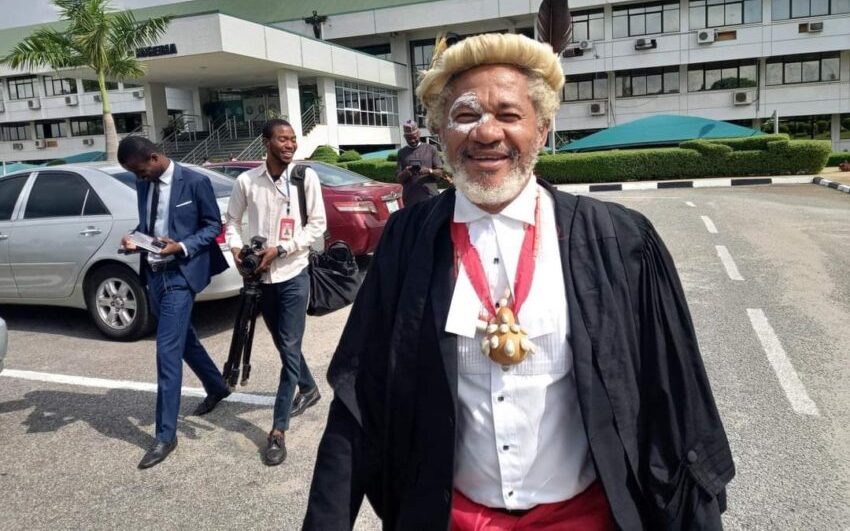
On the 17th day of June, 2022, the Supreme Court in the decision of Suit No: SC/910/16; Lagos State Government & Others v. Asiyat Abdulkareem, held that pursuant to the provisions of Section 38, 1999 Constitution, female Muslim students in public secondary schools have the right to use Hijabs over their school uniforms. All seemed normal until the 23rd day of June 2022, when a Human Rights lawyer, Mr. Malcolm Omirhobo, went to the Supreme Court, dressed in a traditional worshipper’s regalia while still wearing the Barrister’s robe. He wore the usual white shirt commonly worn by lawyers, a makeshift necklace with a small gourd as the pendant, tied a red wrapper around his waist, inserted 2 feathers at the sides of his wig, tied cowries round his two legs [as anklets] and marked a part of his face with white chalk Mr. Omirhobo claimed to be a worshipper of Olokun, the goddess of the Sea in Delta State. He hinged his strange and funny mode of appearance on the interpretation of the Judgement that if Muslim students can wear their religious attires [in the name of propagating and enjoying their faith] in an institution that has a formal and general dress-code, then the same should be extended to lawyers [who also have the right to several religious beliefs] whilst appearing in the Courtrooms.
Picture Credit: waploaded.com
Of course, it is a funny and ridiculous sight to see, but the learned fellow is acting pursuant to the interpretation of the decision delivered by the highest Court of the land.
Now the burning question, what is the logicality or appropriateness of his actions in reconciliation with the Supreme Court’s Judgement?
The Constitution is supreme. No right is to be enjoyed absolutely. In as much as there is the right to religion, there are instances where it can be restricted. In formal institutions where there is a uniformity in dressing, religion has to take a bow and will be side stepped. Never in the Nigerian history do we see a female soldier or personnel adorn the Hijab. It is no secret that Nigerian policemen and military officers do not keep beards. This is funny because many of the top ranking officers are Northerners who are Muslims, and it is an Islamic culture to keep beards. If religion can be restricted here, why not for other institutions like schools and the judiciary? Even one of the Justices of the Supreme Court who sat on that matter, Kudirat M. Kekere – Ekun is a Muslim and has never been seen putting on the hijab while sitting on any matter in Court. Same goes for a former female Chief Justice of Nigeria, Aloma Mariam Mukhtar. These noble lords understand that Law and Religion might at times run on parallel lines; they should not intertwine themselves in certain scenarios.
Lawyers and laymen are split over this. While some believe that wearing the Hijab whether in Court or school is harmless because it goes to the identity of a Muslim woman, others believe that by implication, lawyers too of other religious faiths can wear their religious attires too. Imagine the scene where a Catholic lawyer goes to the High Court with white flowing gown. Well, there is no need to imagine it. Mr. Omirhobo has fed our eyes well enough!
Consequences
The Supreme Court, unintended has left the legal profession in a confused state. Because, while it did not foresee the actions of Mr. Omirhobo and probably others in future, it has set rolling in motion, balls of debates and controversies. Yes, the Rules of Professional Conduct is strict and firm on the dress-code for lawyers appearing in Courts, the Judgement has by implication overridden the provisions of the latter. The Judgement, let us not forget was birthed in the labour room of Constitutional Interpretation. Taking a look at that, the Constitution guarantees the Right to Religion and also establishes Nigeria to be a secular state. So, what are the instances where the right to religion will be restricted or derogated?
Clearly, the Supreme Court did not take these into account while delivering one of the most controversial and heavily talked judgement of all time.
Way Forward
An adage of the South Western Yoruba region of Nigeria, the Yoruba people to be precise goes:
“if we do not know where we are going, we should know where we are coming from”.
In order to prevent the lingering uncertainty and drama ongoing, the Supreme Court has to overrule itself [which would be in another case entirely], or revert to the status quo. Let things be as they used to be which has been the accepted custom and practice of the Nigerian Bar. Religion has an important place in societal development and legal jurisprudence; Laws and Religion often are interwoven and the rights must be safeguarded. However, a statute is superior to any religious doctrine and not the other way around.
The Supreme Court in a race against time to issue clarity on its recent pronouncement. We need to be certain of what the law is at the moment so that there can be Justice and decorum in the profession, because while lawyers are hungry for harmony in the interpretation of the Judgement, all we have for now is chaos for breakfast.
TEAM VERNIA 52B, Adeyemo Akapo Street,Omole Phase I Estate, Off Agidingbi Road, Ikeja, Lagos. +234 813 830 6975 [email protected]